OO Lab
In our lab, we use ultracold atoms to perform quantum simulations and explore the rich physics of low-dimensional quantum gases and strongly correlated many-body systems. In low dimensions, restricted particle motion allows interactions and quantum fluctuations to give rise to collective behavior distinct from that in three-dimensional systems. By building a highly controllable experimental platform, we aim to understand how microscopic interactions determine macroscopic properties, and how an isolated quantum many-body system approaches equilibrium or retains memory of its initial state over long times.
Our experiments use rubidium-85 atoms, with interatomic interactions precisely controlled through a broad Feshbach resonance near 155 G. Optical trapping potentials provide additional control over atomic motion and spatial distributions. Our current research focuses on one-dimensional and quasi-one-dimensional quantum gases. By preparing a single one-dimensional gas in an elongated optical dipole trap, we can directly measure its spatial density distribution and collective excitations, allowing us to investigate the interplay between interactions, temperature, and dimensionality. We have observed an interaction-driven crossover from one to three dimensions without changing the external confinement geometry, revealing the important role of interactions in determining the effective dimensionality of a quantum gas.
We also investigate nonequilibrium dynamics in low-dimensional systems, particularly the connections between localization, integrability, and thermalization. Using a shallow optical lattice combined with harmonic confinement, we have studied Stark many-body localization in the continuous limit. We observed long-lived memory of the initial spatial distribution without random disorder, as well as behavior beyond mean-field descriptions, including enhanced localization at higher initial densities. In another study, we prepared highly excited atoms within a narrow energy window and observed exceptionally slow relaxation from an approximately microcanonical ensemble toward a canonical ensemble. This work explores how integrability and its weak breaking influence thermalization in quasi-one-dimensional systems. Together, these studies provide experimental approaches to understanding the foundations of quantum statistical mechanics and nonequilibrium many-body behavior.
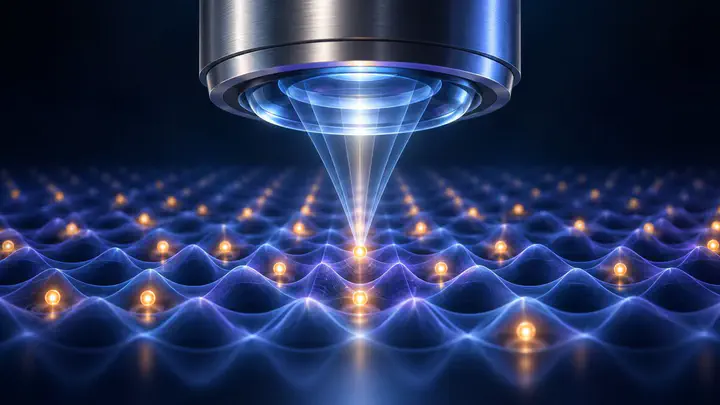
To probe quantum many-body systems at the microscopic level, we have also developed a high-numerical-aperture, long-working-distance optical system for quantum gas microscopy, incorporating a T-shaped vacuum viewport. This development lays the groundwork for single-site-resolved detection. In the future, we will combine optical lattices, tunable interactions, and single-site-resolved quantum gas microscopy to realize and investigate a variety of lattice models. By measuring individual site occupations and correlations between sites, we aim to explore quantum phase transitions, transport, and nonequilibrium dynamics in strongly correlated systems, connecting microscopic quantum behavior with macroscopic many-body properties.